Activities | Wheels
back.roads


California Off Road Areas
Off Road Maps PDFs
Outside Blog - 4x4
Outside Blog - Back Roads
Outside Blog - Off Road
Bureau of Land Management
BLM Sand Dunes
Graded dirt roads, forest service routes, scenic drives on backroads that lead to hiking trailheads, hidden Sequoia groves, unknown waterfalls, amazing views, decent fishing holes, and free, secluded campsites.

|

|
|
Why just wonder where that road leads to? Take the long way home to find out.
UTE 4x4: short for utility, 4WD
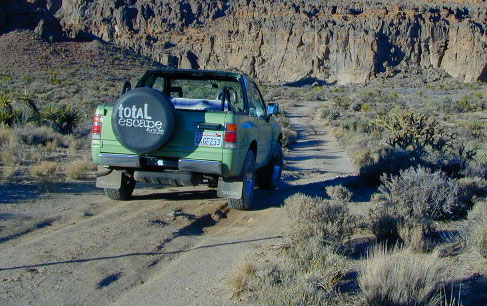
With the last decade of capable utility vehicles coming to market - all-wheel-drive sport wagons to luxurious, off-road camper vans - it makes the initial years of sport-utility-vehicle-mania, look like nothing. Zillion dollar industry to stay the least. Locked and low, 4-wheel-drives, AWD electric, lifted and always ready for a road trip. Overland campers, truck top tents, and smaller quads (side by sides). Find Californians out exploring all year long, any day of the week, in any type of weather, with any type of rig.
|
Locked and low, 4-wheel-drives, AWD electric, lifted and always ready for a road trip. Overland campers, truck top tents, and smaller quads (side by sides). Find Californians out exploring all year long, any day of the week, in any type of weather, with any type of rig.

|
The best scenic drives in California are often so crowded with tourists and traffic, that one can barely concentrate on relaxing. Especially on holiday weekends or summer months, crowds are common in California. You end up cursing the giant RV w/ senior driver in front, instead of taking in the real beauty.
These scenic areas listed on this page likely have small, narrow, unknown back road and remote highways. Many routes without a name, just a number. Some not paved. Many back roads are immpassable in winter months and are gated closed, so call the local rangers ahead of time if you expect snow or a good winter storm.
Indeed, the best roads in California are dirt! Yep, that's cuz there's no traffic jams, no long signal lights & tons of natural beauty. No speeding tho. It is time to quiet the mind & take it all in. Every meadow, every deer sighting, the clouds, the breeze. Thousand of miles of California backroads are awaiting your vehicle. High clearance vehicles, 4x4s & all. Many passenger cars can enjoy these roads as well. There are roads, routes and trails for every level of driver.
Get to know the real California landscape. Finally take that SUV off road & see what it can do. Or at least get dirt on the Subaru. Always remember to Tread Lightly, so we can continue to have access to OUR public lands.
Total Escape can show you how to find the dirt roads that parrallel majestic views, popular highways, canyons, Sierra Nevada scenery & desert vistas. You can stop in the middle of the road to take your photo, if you wish. We recommend not stopping on a curve or blind corner. It's so quiet up here in the forest, with the occasional waterfall or creek trickling. You will not hear the tourist traffic out in these parts. Just the birds, wind in the trees - and your own pulse. You'll be lucky NOT to see another vehcile for hours. Maybe you can find that perfect, secluded camp site you have always imagined, but you'll need a camp fire permit.
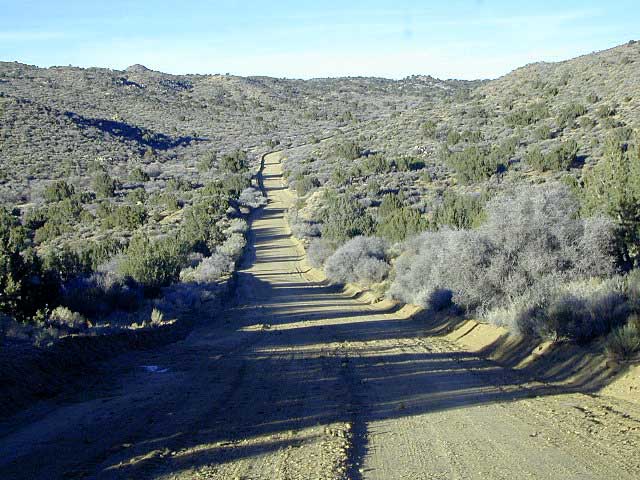
Which brings me to your vehicle. Total Escape has a huge following rural campers, hard-core RVers and the off-road 4x4 dudes/dudettes. Total Escape is about nature, as much as the car that gets us out there. Way out there. Past the masses, beyond the village shops, past the factory outlet mall & behind the RV parks. Many of these back roads in California are somewhat maintained. Graded dirt, granite gravel, well eroded, even overgrown 2 track trails. Some possibly motorcycle or 4x4 only trails. Routes virtually unknown to the common man.
Best to have a high clearance vehicle (SUV, truck, jeep) to explore such dirt roads, but 4x4 is not required for most. (AWD vehicles do okay, if road conditions are not too soggy, snowy, rocky, muddy or steep). 4 wheel drive may be needed on certain snowy, icy or red dirt back roads; Best to always carry snow chains when traveling in mountain elevations higher than 5000' - even in the summer months. Sierra Nevada snow sits til July. And just as a reminder for the newbies, anything in NorCal is a gonna be wetter & snowier than SoCal.
|

|
- Don't gotta 4x4?
most roads are easily passable with 2WD, but you need to be able to judge your own vehicles capabilities
|
|
|
- Frightened about getting lost?
in proper light at home, learn to read a map (well), like a good book; Get GPS; Feel ultra confident w/ reading skies, path of the sun and stars
|
- What's there to do out there?
picnic, camp, fish creeks, hiking, mountain biking, off roading, frisbee, lay in a meadow, look at ladybugs, hear blue birds, see small frogs, star gaze, photography. Bring a hammock, relax or find a waterfall.
|
|
Forested, mountain backroads in higher altitudes can be muddy and/or snowy more than half the year. Be careful when approaching snow on a dirt road. Check the snow & mud depth. Use snow chains or 4 wheel drive if unsure. Snow cables do not have the traction needed for back road driving.
Think first; or.... you may walk 3 miles to get a nearby Subaru (full of rock climbers) to pull you out, or worse, you may hike longer up hill, just to get a cell signal (in the dark, freezing cold). Tow trucks, or local yokels, usually charge big bucks ($$$) to help YOU out of a bad predicament/stupid situation, on a remote backroad in the boonies; that is, if you can find them or vice versa.
Total Escape is compiling a huge list of all local California tow truck drivers and 4WD clubs that are willing to go pull you outta a 'dirt road situation'. 4X4 Towing in California: If you know of a great local tow shop like that, tell them to submit their info.
|
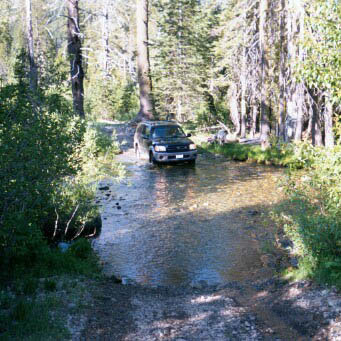
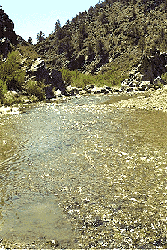
CALIFORNIA CREEK CROSSINGS are pretty common on dirt roads and mountain backroads. If you are lucky, there is a cute one lane bridge, but all too often not. Drive through flowing water, slow but steady and keep your foot on the gas pedal (so you will not suck water up your tailpipe).
Proceed foward with caution. There may be oncoming traffic, on the road ahead or hikers, horses, dirt bikes, ATVs nearby or in the stream. Trailhead junctions are popular spots and trails often insect at creek beds.
go slow dude!
NOT LIKE THE COMMERCIALS ON TV. Cute lil animals & delicate wildflowers live at water sources. Plus erosion of rock & soil is strong enough, without you adding to the process.
Another reason to drive slow: A cracked engine part! What happens when you mix cold (snow melt) rushing water and a hot exhaust manifold? Steam and if conditions are right, a serious crack; damaging to say the least. Which is costly to repair, not to mention the tow truck fee.
|
 |
 There are plenty of dirt roads to be explored in California. Leading to such interest as: meadows, waterfalls, indian pictographs, mud caves, wind tunnels, great view points & most of all, seclusion. It's time to use that new Sport Utility Vehicle for what it's made for. But please respect the earth & the wildlife, stay on the trails & pick up any litter you find. Some of these roads can be accessed by normal passenger cars as well. It's a perfect way to really get away from the crowds. There are plenty of dirt roads to be explored in California. Leading to such interest as: meadows, waterfalls, indian pictographs, mud caves, wind tunnels, great view points & most of all, seclusion. It's time to use that new Sport Utility Vehicle for what it's made for. But please respect the earth & the wildlife, stay on the trails & pick up any litter you find. Some of these roads can be accessed by normal passenger cars as well. It's a perfect way to really get away from the crowds.
|

Driving Tips
Many backcountry roads can be accessed by passenger cars, but use wise judgment when entering unfamiliar territory. SUV or 4x4 may be required for some roads. Know your cars limits.
- Most of these back roads are one lane & narrow. Be aware of on-coming traffic.
- Pass slowly & cautiously.
- Drive with lights on, even in the day time. You can see lights thru bushes easier than a dark vehicle.
- If road seems to be worsening, chances are it will get a lot worse a few miles down. Pick a good spot to turn around when you are hesitant or unsure.
- Try not to travel these roads at night, unless you are familiar with it. There are no markers & can be very dangerous.
- A patch of snow on a dirt road in spring/summer may look harmless, but there is guaranteed thick mud underneath. Be weary of snow on dirt roads if you don't have a 4 wheel drive vehicle.
- Try not to stop or even slow down in soft sandy washes. Chances are you will get stuck, unless you have 4 wheel drive & then it is sometimes still questionable.
- Beginners should not speed on dirt roads, especially on long straight aways. Dips & slight bumps & turns can be dangerous at a high rate of speed. Vehicles handle a lot differently on dirt roads.
- Down shift, instead of braking, around curves to control your grip.
- Straddle a deep rut in the road. Placing tires on each side of the trench, to prevent unbalanced driving.
- Go slowly over big dips in order to prevent bottoming out your vehicle.
- Bring emergency gear when traveling on back roads: flashlight, shovel, matches, blankets, water, tow strap, cell phone

More on back road travel
A sign for '4x4 required' usually means difficult or bumpy terrain ahead. Know how to use your vehicle's limitations & if you are at all hesitant (maybe your SUV is only 2WD or AWD), take another look from outside of the vehicle. Come back at a later date with a 4x4 pal for further exploration.
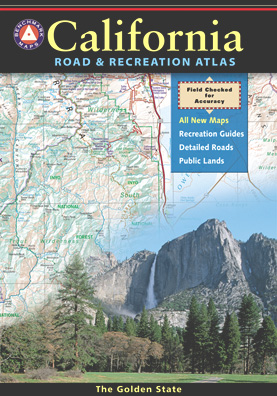
National Forest USDA maps show dirt roads, lakes, creeks & campgrounds; Benchmark California Atlas is a great overview for the entire state & Tom Harrison makes waterproof back roads maps for popular California destinations.
Safety off-road
Soft Sand: Don't stop in soft sand. Even 4WD vehicles can get stuck. Bring a shovel, old lumber pieces or an old blanket or tarp to help get out of super soft sandy spots. Or better yet, another vehicle with a tow strap.
Fire Danger: Your catalytic converter can cause a wildfire if you are parked ontop of dry brush for more than a few seconds. Be cautious as to where you pull over & pick a clear spot without weeds or dry wildflowers.
Recent Rains: Dirt roads conditions can change with each season, as the earth's erosion continues. If the road quality is in question, walk the worst parts first to check it out and be sure. Watch for deep gullies and boulders in the road way. Snow patches can be deceiving. There may be one foot of deep mud under that 6 inches of old icy hard snow. Use 4WD - or you could end up walking miles for help.
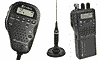
Cell Phone Coverage: Remote areas of California and most forest back roads have NO SIGNAL (digital or analog). If you do find signals, they may be weak. Standing still helps the connection if you find one. CB and ham radios are popular off-road accessories.
|
|
RIGHT OF WAY
on a one lane dirt road
Passing on steep hills - the driver with the nearest pull out should reverse to that spot. But if no pull outs are in sight...
When two vehicles meet on a steep road where neither can pass, the vehicle facing downhill must back up until the vehicle going uphill can pass. (The driver facing downhill has the greater amount of control when in reverse, cuz they don't have the gravity to deal with)
|
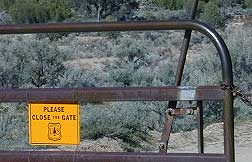
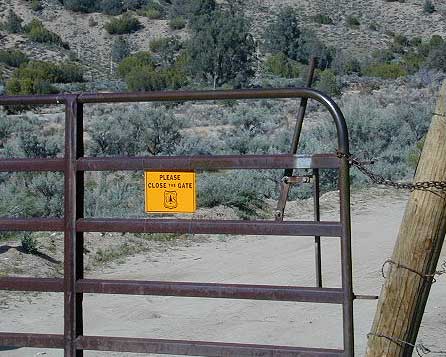
Please respect the private lands along these roads & help keep the cattle in their place. Close the gate along the backroads.
|
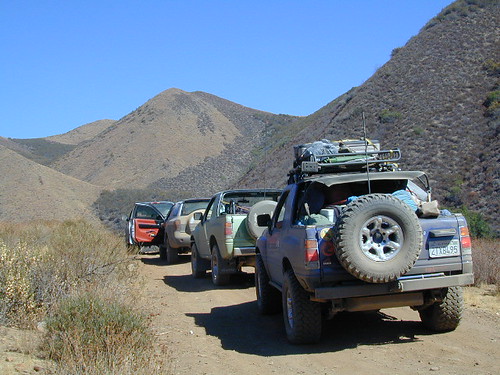
remember when traveling w/ a group or caravan, communication is key
|
Forest
Service Signs &
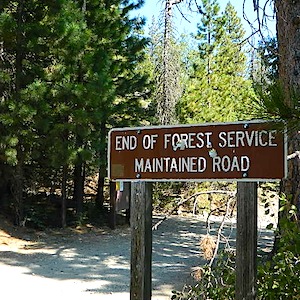
Back Road Wilderness Signage
NOTE: High Clearance could be required on any dirt road. 2WD vs. AWD vs. 4X4 - know the difference. Know your vehicles capabilities, bring another rig along when possible & always have a tow strap and a few good maps.
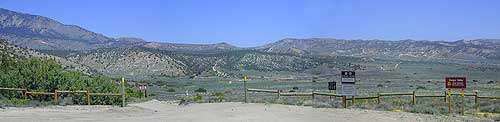
NFS National Forest route signs:
- posted at road entrances & maybe at dirt road intersections
(if you're lucky)
- white numbers on brown background
- the route numbers are found on forest maps & topo maps & on Total Escape's California Back Roads Mega List
Maintained Roads: 
- horizontal signs for roads kept up for passenger cars
- pavement, gravel, dirt (or a combination of surfaces)
Non-Maintained Roads:
- minimal up keep, usually bumpy dirt roads
- vertical signs for high clearance vehicles
- not maintained for passenger cars

There are plenty of dirt roads to be explored in California. Leading
to such scenic interest as meadows, waterfalls, indian pictographs, great
view points & most of all, seclusion. It's time to use that
new Sport Utility Vehicle for what it's made for & a perfect
way to really get away from the crowds. Most of these are located
in National Forest or BLM land. Read all entrance signs &
remember, 'private roads' are most likely no entry. Do not even
think of taking a road marked 'closed'.
National Forest Service Maps are extremely helpful
when venturing off pavement to dirt roads. Most really good primitive
camping areas are located on these dirt side roads. Get off the
beaten path & find that perfect meadow, waterfall or creek
side spot.
Great Areas
with Dirt Roads in California
Sierra Nevada & California Desert Backroads |
| region name |
general area |
nearby town |
| Black
Canyon BLM |
north
of I-15, west of Barstow |
Barstow CA |
| Canebrake
/ Chimney Pk |
north off
Hwy 178 |
Kernville CA |
| El
Dorado National Forest |
areas east
of Historic Gold Country |
Placerville CA |
| Hollister Hills OHV |
oak foothills Central Valley |
Hollister CA |
| Inyo
National Forest |
Eastern Sierra
off Hwy. 395 |
Bishop CA |
| Los
Padres NF |
Coast regions
around Nacimiento Rd |
Big
Sur CA |
| Mojave
National Preserve |
between I-15
& I-40, near Essex |
Barstow CA |
| Plumas
National Forest |
anywhere off
of Hwy. 70 |
Quincy CA |
| Sequoia
National Forest |
Hwy.190, Western
Divide Hwy. & SM99 |
Ponderosa CA |
| Sierra
National Forest |
Hwy 168 near
Shaver Lake |
Lakeshore CA |
| Stanislaus
National Forest |
Hwy. 108/Beardsly Lake, E Gold
Co |
Sonora CA |
| Tahoe
National Forest |
I-80 &
all around the vicinity |
Truckee CA |
| Toiyabe
National Forest |
Eastern Sierra
off Hwy. 395 |
Bridgeport CA |
4x4 routes, dirt roads, california back roads, 4 wheel drive trails, baja backroads, dirt trails 4WD
|
Northern California Backroads |
| region name |
general area |
nearby town |
| Klamath National Forest |
W of Interstate 5, west of
Mt. Shasta |
Yreka CA |
| Mendocino
National Forest |
W of Interstate 5, above Clear
Lake |
Ukiah CA |
| Modoc
National Forest |
NE California, N Hwy. 395 |
Alturas CA |
| Six
Rivers National Forest |
E of north coast, Hwy.36,
299 & 96 |
Eureka CA |
| Shasta
Trinity National Forest |
W of Shasta Lake & Interstate
5 |
Dunsmuir CA |


|
Total Escape California Camping
Advertisement
|
|